
Cloudmeter’s Big Data Network Analytics Enables Integrated Application Performance Management

Cloudmeter today announces the general availability of Cloudmeter Stream, a non-invasive platform that enables customers to transform Big Data streams of network data into actionable business intelligence. Cloudmeter also announces the early access availability of Cloudmeter Insight, a SaaS application that integrates back-end network analytics with front-end marketing analytics to deliver integrated data regarding user experiences of application platforms. Together, Cloudmeter Stream and Cloudmeter Insight expand the purview of Big Data analytics to network data and enable customers to obtain a 360 degree view of user interactions with their products. Both Cloudmeter Stream and Cloudmeter Insight allow access to network data without risks of physical disruption to network infrastructures.

Cloudmeter’s analytics represent an extension of the DevOps movement by allowing operations to more effectively understand the impact of IT infrastructure on end-user experiences. Application owners can use Cloudmeter to effectively configure business rules to determine which network data attributes constitute fields of interest. For example, customers can create business rules that identify session errors, network traffic on specific servers or data regarding the elapsed time between specific interactions with the platform. Users create business rules and manage the application more generally using an intuitive user interface featuring screens such as the following:
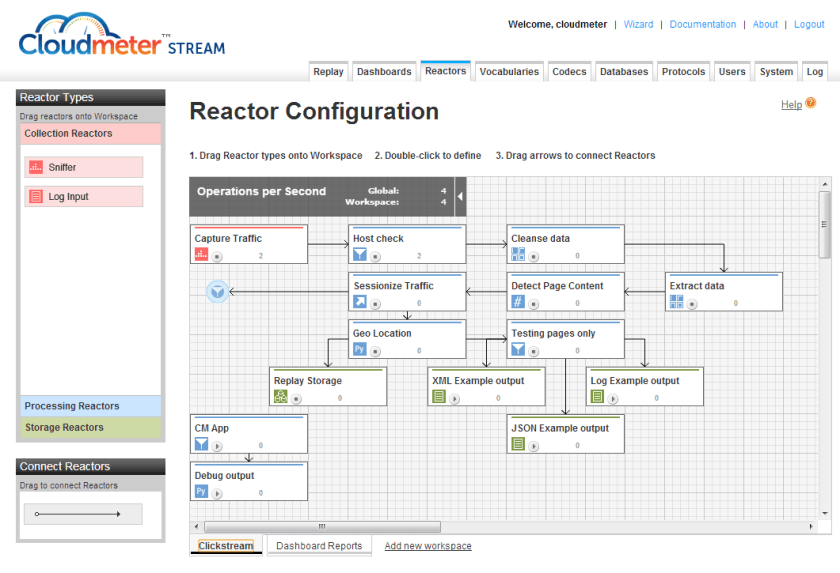
Cloudmeter CEO Mike Dickey remarked on the innovation represented by the platform for capturing network data by noting:

Our new data capture technology is a culmination of many years of experience building network-based data capture products. It enables customers to gain real time access into the wealth of business and IT information without the need to connect to physical network infrastructure, and without introducing risk to production systems or application performance.

Dickey underscores how Cloudmeter’s technology brings the Big Data revolution to network data and concomitantly empowers customers to access “business and IT information” in ways that have the potential to transform both their marketing platforms as well as their IT infrastructure design. In an interview with Cloud Computing Today, Cloudmeter’s COO Ronit Belson remarked that, rather than falling into the category of DevOps products, the company’s platform more appropriately represents a disruptive innovation in the MarkOps space defined by the integration of marketing-related front-end application design with the Operations-related design of their platform’s IT infrastructure. Cloudmeter Stream integrates with Big Data platforms such as Splunk and GoodData allowing users to integrate petabytes of machine data with data selectively culled from the business rules specific to Cloudmeter’s user interface.

Cloudmeter Stream is complemented by Cloudmeter Insight, a SaaS application that transforms data captured by Cloudmeter Insight into visual representations that allow application owners to comprehensively understand end-user experiences of an application as represented below:

Cloudmeter Stream leverages widgets to allow users to customize reports and dashboards of their choosing. The result is an integrated view of an application’s backend and front-end user experience in ways that allow application owners to obtain a truly holistic picture of user experiences with their platforms. Today’s announcements point toward two exciting new releases into the application performance management space as Big Data begins to own up to its potential of delivering 360 degree views of user experiences with technology platforms. Cloudmeter’s customer base includes Netflix, SAP and Saks Fifth Avenue and 1-800-Flowers.

Concurrent Finalizes $4M In Series A Funding; Announces New CEO Gary Nakamura

Today, Concurrent Inc. announced the finalization of $4 million in Series A funding led by True Ventures and Rembrandt Venture Partners. The investment is intended to accelerate product development and expand the core team as part of the company’s larger project of simplifying application development within the Hadoop space. In conjunction with news of the funding, Concurrent also announced the appointment of Gary Nakamura as CEO. Nakamura comes to Concurrent with an illustrious tenure at Terracotta as Senior Vice President and General Manager and VP of World Wide Sales & Field Operations. Chris Wensel, Concurrent’s Founder and former CEO, will assume the role of CTO. Concurrent’s $4 million in Series A funding builds upon an initial seed investment of $900,000 in August 2011 that was similarly financed by True Ventures and Rembrandt Venture Partners. The Series A funding points to the success of Concurrent’s Cascading 2.1 platform for simplifying application development and management on Hadoop clusters.

Cascading delivers a framework that empowers developers to use Java languages to develop applications that operate on Hadoop instead of MapReduce. Used by the likes of Twitter, eBay and The Climate Corporation, Cascading joins forces with Concurrent’s platform Lingual, which provides a SQL interface for operating on Hadoop, in a concerted initiative to democratize developer access to Hadoop. In an interview with Cloud Computing Today, CEO Gary Nakamura noted that Concurrent intends to build on its initial momentum by delivering platforms that simplify and streamline application development on Hadoop as opposed to opting for the strategy of releasing a Hadoop distribution in the vein of Intel, EMC and others.

Concurrent already boasts partnerships with the likes of Amazon Web Services and Microsoft Azure for managing application development and management within Hadoop infrastructures. Its Cascading framework is compatible with all Apache Hadoop distributions and claims more than 75,000 downloads per month. Given Concurrent’s notable acccomplishments with modest funding to date, the company is likely to expand its footprint in the space dedicated to simplifying Hadoop application development as a result of its new funding and CEO Gary Nakamura’s deep experience with enterprise software. As Hadoop distributions proliferate, expect to see the demand for simplified Hadoop development and management products skyrocket within the enterprise. Enterprise concerns about data security and consistency of application lifecycle management are additionally likely to fuel the demand for Hadoop management platforms, particularly given the increasing convergence between Big Data and cloud-based infrastructures.

Zettaset Wraps Its Orchestrator Around Intel’s Hadoop Distribution

Big Data management vendor Zettaset recently announced support for Intel’s distribution of Hadoop. Zettaset’s support of Intel’s Hadoop distribution means that its Zettaset Orchestrator platform for simplifying and streamlining Hadoop deployments can be deployed on Intel’s open source Hadoop distribution that it optimized for its Xeon processor platform. Zettaset CEO and President Jim Vogt remarked on the company’s collaboration with Intel by noting:

Intel has worked diligently with their partners to ensure compatibility and deliver a robust, high performance Big Data solution for the enterprise. We are excited to be included in Intel’s growing Big Data ecosystem and look forward to helping our joint customers to easily install, manage and secure their Intel-powered Hadoop deployments.

The partnership means that Intel Hadoop customers have the opportunity to leverage Zettaset’s suite of Hadoop management tools that address security policy, compliance, access control and security in an effort to facilitate the construction of enterprise-grade Hadoop clusters. Zettaset is designed to support any Apache Hadoop distribution and environment.

Three Key Features Of EMC’s Hadoop Distribution, Pivotal HD

This week, EMC launched its own distribution of Hadoop under the branding Pivotal HD. Built on technology that EMC obtained through the acquisition of Greenplum in July 2010, Pivotal HD represents EMC’s next iteration on the Greenplum Unified Analytics Platform (UAP) that it launched in December 2011. The Greenplum UAP featured EMC Greenplum HD, an enterprise-grade distribution of Hadoop and Greenplum’s database for structured data. Greenplum UAP also announced Greenplum Chorus, an innovative platform for collaboration amongst data scientists in an organization leveraging Big Data. Pivotal HD, however, marks a significant new chapter in EMC’s Hadoop technology as indicated by its array of features and architectural complexity.

Like many recent Hadoop distributions and technologies, Pivotal HD integrates with SQL to facilitate its maximal usage by developers and business analysts who lack familiarity with MapReduce. But the real innovation of Pivotal HD runs deeper than its integration of SQL with Hadoop and concerns the positioning of Greenplum’s analytic engine alongside HDFS in ways that enable performance enhancements to Hadoop querying over and beyond the simple appendage of a SQL interface. Pivotal HD’s Advanced Database Services (HAWQ) allows for the delivery of a high-performance SQL engine that permits of greater SQL functionality and performance than analogous SQL interfaces such as Hive, Hadapt and Impala. Coupled with Pivotal HD’s virtualization and pluggable storage compatibility features, the platform represents a distinct moment of innovation in the Hadoop space as evinced by the following three features:

Advanced Database Services (HAWQ)
Pivotal HD’s Advanced Database Services (HAWQ) functionality brings Greenplum’s Massively Parallel Processing (MPP) functionality to Hadoop. The result means that HAWQ allows Pivotal HD users to perform complex joins, MADlib in-database analytics and transactions. Moreover, users have the luxury of leveraging virtually any BI tool on the marketplace to obtain advanced reporting and visualization of data as required. HAWQ-based SQL queries outperform Hive in terms of response time by as much as 100x according to EMC benchmarking data.

The Advanced Database Service interfaces with other components of Pivotal HD as follows:

EMC Pivotal HD

Given the recent proliferation of SQL-Hadoop interfaces throughout the industry, customers and analysts should expect more data about the comparative efficiencies of SQL-Hadoop interfaces to emerge as more and more SQL-trained analysts start using SQL to operate on data saved in HDFS.

Hadoop Virtualization Extensions
Hadoop Virtualization Extensions enable the provisioning of Hadoop clusters on VMware virtualized platforms in both public cloud and on-premise environments. HVE provides customers increased flexibility of deployment and enables the construction of high availability infrastructures for the access of Hadoop data.

Pluggable HDFS Storage
Customers can multiply their data storage options by using standard Hadoop direct attached storage in addition to EMC Isilon OneFS Scale-Out NAS Storage, the latter of which features streamlined loading, backup, replication, snapshotting and elastic scalability functionality.

Analysis
Overall, EMC’s launch into the Hadoop-distribution world represents a stunning and significant move to grab Hadoop market share from Cloudera, Hortonworks and MapR. Unlike Intel’s recently launched distribution, EMC’s Pivotal HD claims some proprietary and genuinely innovative Hadoop technology in the form of its Advanced Database Services engine and scale-out storage compatibility. Expect EMC to continue to innovate upon its core technology platform and follow the suit of the likes of Concurrent in developing tools to render Hadoop more accessible to Java-based developers in addition to SQL. What remains unclear, at this point, is the extent to which EMC will open-source its technology as it gains market share within the enterprise. For now, however, the Hadoop world has yet another significant player with cash reserves aplenty to continue to innovate on its platform and disrupt the Hadoop landscape in the process.

Concurrent Announces Lingual To Facilitate Hadoop Adoption For SQL Users

This week, Concurrent Inc. announced details of Lingual, a project designed to facilitate adoption of Apache Hadoop by empowering SQL users to leverage their SQL skills to create applications applications that run on Hadoop without training in MapReduce. Lingual presents developers with an ANSI-standard SQL interface that is compatible with all major Hadoop distributions. Using Lingual, developers can utilize SQL code to run against data stored within Hadoop clusters. Moreover, developers and data scientists can use Lingual to export data directly into BI tools. Developers can also use Lingual to create new Hadoop-based applications using the platform’s JDBC interface or Cascading APIs and languages, such as Scalding and Cascalog. Lingual runs on Concurrent’s Cascading platform for simplifying Hadoop development for Java developers. Cascading allows developers to use Java languages to create processes and applications within a Hadoop cluster without learning the intricacies of MapReduce. Lingual represents a fitting extension of Cascading’s mission to facilitate the development of applications that run against Hadoop clusters by expanding the required developer skill-set from Java to include SQL.

Joyent Launches Big Data Hadoop Solution Based On Hortonworks Distribution

This week, Joyent announced the launch of a Big Data solution based on the Hortonworks distribution of Apache Hadoop that delivers enterprise-grade Hadoop storage and analytics on its high performance cloud infrastructure platform. Joyent claims that its infrastructure allows for accelerated distributed and parallel processing in addition to improved scaling of Hadoop clusters. Moreover, Joyent noted that Hadoop clusters running on its cloud were three times faster than clusters running on infrastructures of identical size. Speaking of the product launch, Joyent’s CTO Jason Hoffman remarked that its Hadoop offering “is just the start of our 2013 agenda.” Hoffman elaborated that the company intends to bring its innovation to Big Data as well as the cloud:

We intend to continue bringing our technical expertise to the market and reverse the typical understanding of big data implementations — that they’re expensive and hard to use. We’re committed to meeting the insatiable demand for faster analytics and data retrieval, changing how computing functions for the enterprise.

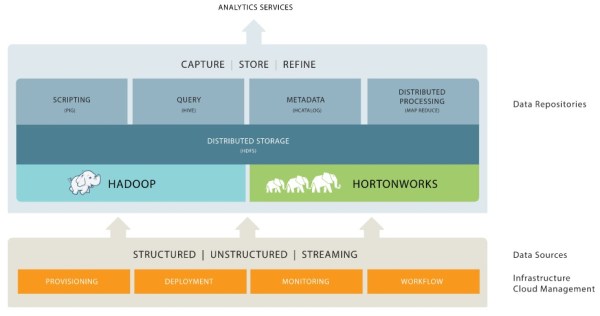
Joyent offered a schematic of its Hadoop infrastructure as follows:

On its website, Joyent identified three types of Hadoop services: (1) Data platform services for archiving and securing Hadoop-based data; (2) Data storage services that focus on data analysis and retrieval; and (3) Data management services that allow for the effective management of Hadoop clusters and ecosystems.