
Amazon Web Services Continues To Increase IaaS/PaaS Market Share According To Synergy Research Group

A recent article by the Synergy Research Group (Synergy) claims that Amazon Web Services continues to dominate the IaaS and PaaS space in terms of revenue. According to Synergy, Amazon Web Services increased its quarterly revenue by 55% to over $700M in Q3 of 2013, whereas the aggregate of revenue for Salesforce, IBM, Windows Azure and Google was less than $400M for the same time period. Worldwide, total IaaS and PaaS revenues exceeded $2.5 billion for the quarter, with IaaS accounting for 64% of cloud revenues, a surprisingly small proportion given the limited penetration of platform as a service within the enterprise. Synergy Research’s John Dinsdale remarked on the company’s findings as follows:

We’ve been analyzing the IaaS/PaaS markets for quite a few quarters now and creating these leadership metrics, and the relative positioning of the leaders really hasn’t changed much. While Amazon dwarfs all competition, the race is on to see if any of the big four followers can distance themselves from their peers. The good news for these companies and for the long tail of operators with relatively small cloud infrastructure service operations, is that IaaS/PaaS will be growing strongly long into the future, providing plenty of opportunity for robust revenue growth.

Here, Dinsdale remarks that the “race is on to see if” Salesforce, IBM, Microsoft and Google can decisively secure second place in the battle for IaaS/PaaS market share. Strikingly, Microsoft, Google and IBM have revenues that are very close to one another, even though one might reasonably expect Microsoft’s Azure platform to edge out its competition given its earlier entry into the market than IBM and Google’s Compute Engine (GCE). That said, IBM’s sizeable IaaS revenue derives largely from its acquisition of SoftLayer, which itself had a rich and venerable history that predated IBM.

Synergy’s chart illustrating Q3 IaaS and PaaS revenues is given below:

Notable omissions from the findings include Rackspace, HP, Oracle, Pivotal One and Red Hat, the middle three of which (HP, Oracle and Pivotal One) are still relatively nascent, and hence justifiably excluded from the present calculation. As Dinsdale notes above, however, “the good news for these companies” and for remainder of the space is that revenues are set to increase significantly in the near term. Going forward, one of the key questions for subsequent IaaS market share analyses will be whether OpenStack’s momentum and gradual maturation propels disproportionate growth amongst OpenStack-based cloud platforms for vendors such as HP, IBM, Oracle, Rackspace and Red Hat.
Kaseya Launches SaaS Monitoring Tool For Hybrid Clouds And Distributed Computing Environments

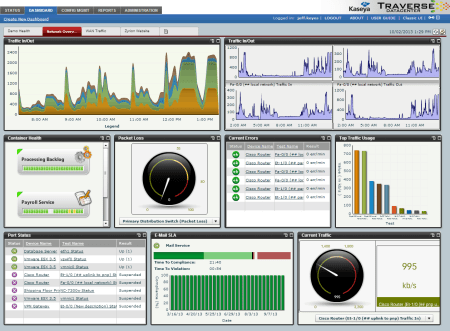
Today, Kaseya announces the general availability of Kaseya Traverse, its SaaS cloud monitoring solution for on premise, private cloud and public cloud environments. The uniqueness of Kaseya Traverse consists of its ability to “traverse” a multitude of cloud infrastructures while delivering centralized, integrated reporting for the entire ecosystem in question. Whereas proprietary cloud monitoring solutions such as CloudWatch by Amazon Web Services deliver performance reporting and monitoring solutions specific to their own, native cloud infrastructure, Kaseya Traverse can be configured to monitor a heterogeneous cloud environment marked by the coexistence of several hosting technologies and platforms. The Kaseya solution provides a diverse range of performance monitoring and analytics on hardware, networks, applications and usage patterns as illustrated by the dashboard below:

Kaseya leverages an architecture designed for distributed analytics, data processing and data gathering that fittingly corresponds to the task of monitoring the infrastructures of dispersed, heterogeneous IT environments. The platform features SLA monitoring, issue identification and resolution with respect to application performance and machine learning-based analytics that identify true anomalies in traffic or usage related patterns as opposed to organic variations and cycles. Given that the current state of enterprise cloud computing almost invariably features some combination of on premise, private cloud and public cloud deployments, Kaseya Traverse is likely to be well received by customers that are seeking a centralized monitoring, reporting and analytics solution in contrast to an amalgamation of discrete reporting applications. Moreover, its ease of deployment as a SaaS application and distributed computing capabilities render it a particularly attractive cloud monitoring tool insofar as its architecture is designed with the specific needs of heterogeneous cloud computing environments in mind.

AlgoSec Releases New Version Of Network And Security Suite For Data Center Migrations To Cloud

Today, AlgoSec announced an upgrade to its AlgoSec Security Management Suite. The AlgoSec Security Management Suite streamlines data center migrations to private, public and hybrid clouds by using automated rules to simplify the detection of the parameters undergirding network infrastructures and the objects that support the effective functioning of applications. As a result, customers can perform data center migrations while ensuring the continued performance of mission-critical applications. As part of its migration process, the AlgoSec Security Management Suite maps and understands the impact of network topologies, firewalls, routers and switches on the infrastructure’s applications. AlgoSec’s solution additionally features baseline snapshots of the configuration of firewalls and routers that enable customers to assess their post-migration environment.

Separate from delivering the nuts and bolts of a data center migration solution, the AlgoSec Security Management Suite manages the effective implementation of network security during migrations. The platform allows customers to manage security protocols and “complex policies across firewalls, routers, switches and secure web gateways” in ways that bridge the divide between network and security operations, according to the company’s press release. Moreover, the AlgoSec solution focuses on delivering the network and security configuration that maximizes application performance and availability.

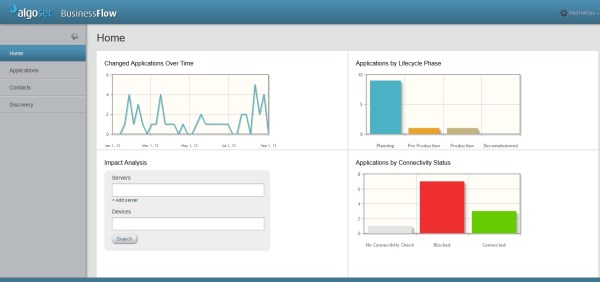
One of the key features of the AlgoSec Security Management Suite features the ability to visualize the ecosystem specific to applications and their performance before and after a migration by using its Business Flow tool. Business Flow provides insight into application performance and status as illustrated below:

The larger consequence for customers is that AlgoSec provides granular data about the integration of network and security with an application-centric focus that enables IT administrators to closely monitor application performance both before and after data center migrations. AlgoSec currently boasts over 1000 customers including 15 of the Fortune 50. As cloud implementations featuring migrations of on-premise data centers to private and public clouds proliferate, the industry should expect more and more customers to leverage off the shelf solutions to facilitate data center migrations and manage the trifold challenge of network, security and application performance. AlgoSec’s uniqueness consists in its ability to play at the intersection of network and security operations, and in this vein we should expect more players to join this space as cloud adoption accelerates.

Tasmanian Government Selects Annitel To Deliver IaaS GovCloud Platform

The Tasmanian government has selected Australian IT & Telecommunications company Annitel to provide an Infrastructure as a Service solution for an initial period of two years. The size of the contract will be determined by uptake from Tasmanian government agencies, although “several” agencies reportedly have plans to use Annitel’s IaaS offering as soon as it becomes available. The Tasmanian government’s decision to select Annitel illustrates the global quality of government interest in cloud platforms. In the U.S., for example, Oracle recently launched an Oracle Government Cloud platform in an effort to compete with Amazon Web Services, IBM and Google in the government cloud computing space. Annitel’s IaaS platform for the government of Tasmania is expected to become available sometime in October.

Incapsula Delivers Platform For Customizing Caching Parameters

As demonstrated by recent caching-related announcements from Amazon Web Services and Microsoft, caching is hot topic in cloud computing these days. Last week, Amazon Web Services announced the Beta availability of the open source caching platform Redis as a complement to Memcached within its ElastiCache platform. Meanwhile, Microsoft announced news of its own Windows Azure Cache with greater cache sizes and reduced latency times. This week, Incapsula stoked the debate about optimal caching services for web-based applications by deciding to grant its customers an unprecedented degree of control over the caching parameters used to dictate which components of a website are cached and how.

On Tuesday, Incapsula announced an enhancement to its website acceleration platform by empowering application owners and IT administrators to customize the caching and acceleration parameters that govern the delivery of content to their website. As a result, application owners can control the delivery of content to web-based applications by determining which components of the application can be cached, and which need to be dynamically refreshed. Incapsula’s decision to lift the hood on the caching parameters for its web-based applications means that software engineers can (1) specify how a site’s content is cached and refreshed at a resource level; (2) implement asynchronous validation; (3) compress dynamic resources and (4) optimize the performance of network resources.

Incapsula’s delivery of customized caching functionality is enabled by an impressive user interface as follows:

In addition to a framework for enabling users to tweak caching parameters, Incapsula’s performance management platform tells engineers how their customized caching configurations are performing in order to enable them to gauge the efficacy of their caching strategy. The obvious question, now, of course, is whether other content delivery networks and hosting platforms with caching services will follow suit and grant users analogous degrees of flexibility regarding caching customization.

Survey Reveals Sequence Of Online Research That Drives Retail Shopping

A recent survey from Wanderful Media and Dimensional Research quantifies how consumer shopping experiences are increasingly driven by online experiences. Data about the effect of online shopping platforms on consumer shopping in brick and mortar stores underscores the importance, for retailers, of building rich and enticing online infrastructures around their products. Findings from the study indicated that store websites, online marketplace stores such as Amazon and social media all played significant roles with respect to the research done by consumers within a store.

Getting Consumers Into A Store

Emails, coupons, online advertisements, online store searches and social media all played a role in driving consumers into brick and mortar stores as illustrated below:

Online promotions and marketing of stores outweighed social media recommendations from friends by a factor of more than two.

Devices Used For Consumer Research In Stores

Smartphones represented the dominant platform for consumer research while in stores. Despite the significance of online marketing in getting consumers into stores, consumers continued to research and refine their shopping preferences using online research. In other words, online marketing had an initiatory effect on brick and mortar shopping experiences that consumers subsequently refined and finalized in collaboration with smartphones and tablets once in stores.

While the study powerfully illustrates the significance of the relation between brick and mortar shopping and online shopping and research, it hardly signals the death of the brick and mortar shopping. On one hand, online shopping drives retail shopping but retail shopping, conversely, leads to more targeted online product research and comparison shopping. All this suggests that big data analytics by retailers on online sales should consider the points of origin of online consumer research and strive toward constructing a holistic picture of the trajectory of a consumer’s online product research. Preliminary findings indicate that more focused consumer research happens in stores, on smartphones. The implication here is that retailers should increasingly focus on the richness of their positioning of products in smartphone-powered search platforms in ways that complement the efficacy of their email and online promotions that drive consumers into stores, in the first place.

Complete details of the study can be found here: http://bit.ly/UDNbai