
Basho Technologies Raises $25M In Series G Funding And Announces Record Growth In 2014

Basho Technologies, creator of the Riak NoSQL key-value database platform, today announced the finalization of $25M in Series G funding led by existing investor Georgetown Partners. In addition to the funding news, Basho revealed details of record growth including sequential growth of 62 percent and 116 percent in Q3 and Q4 of 2014 respectively. 2014 represented a landmark year for Basho given that it shipped Riak 2.0, Riak CS 1.5 and appointed Adam Wray, former CEO of Tier 3, as CEO. In the same year, Basho replaced Oracle as the database platform for the National Health Service of UK and deepened its relationship with The Weather Company as noted below by Bryson Koehler, executive vice president and CITO for The Weather Company:

The amount of data we collect from satellites, radars, forecast models, users and weather stations worldwide is over 20TB each day and growing quickly. This data helps us deliver the world’s most accurate weather forecast as well as deliver more severe weather alerts than anyone else, so it is absolutely mission critical and has to be available all of the time. Riak Enterprise gives us the flexibility and reliability that we depend on to enable over 100,000 transactions a second with sub 20ms latency on a global basis.

Here, Koehler remarks on the ability of Riak Enterprise to handle “over 100,000 transactions a second” with latencies less than 20 ms. Importantly, The Weather Company’s daily data collection rate of 20 TB a day illustrates the massive volumes of data that Enterprise Riak can aggregate for archival and analytic use cases. As told to Cloud Computing Today in an interview with Basho CEO Adam Wray, Riak also gained traction in verticals such as gaming, healthcare and financial services in 2014 with much of its uptake propelled by trends in the technology industry marked by increased adoption of Big Data, distributed systems and applications in the cloud computing space and the growth of the internet of things vertical. Wray further remarked that Riak stands strongly positioned to reap the benefits of increased stakeholder awareness about the value of key-value stores and concepts such as eventual consistency. Today’s capital raise brings the total funding raised by Basho to $65M. With an extra $25M in the bank and an enviable roster of enterprise customers out of the gate, the NoSQL space should expect Basho to build steadily upon its success in 2014 by gaining even more market traction amongst Fortune 50 customers and staking out its positioning amongst the likes of MongoDB, MarkLogic, Couchbase and DataStax, with a particular focus on sharpening its differentiation in comparison to other key-value store databases such as Couchbase and DataStax.

Internet Of Things Predictions For 2015 From ParStream

The following represent Internet of Things Predictions from ParStream, the company behind the analytics platform built for the internet of things.

1. The Rise of the Chief-IoT-Officer: In the not too distant past, there was an emerging technology trend called “eBusiness”. Many CEO’s wanted to accelerate the adoption of eBusiness across various corporate functions, so they appointed a change leader often known as the “VP of eBusiness,” who partnered with functional leaders to help propagate and integrate eBusiness processes and technologies within legacy operations. IoT represents a similar transformational opportunity. As CEO’s start examining the implications of IoT for their business strategy, there will be a push to drive change and move forward faster. A new leader, called the Chief IoT Officer, will emerge as an internal champion to help corporate functions identify the possibilities and accelerate adoption of IoT on a wider scale.

2. Analytics Will Be the #1 Priority for IoT Initiatives: 2014 was about sensors and devices. The initial objective of many IoT projects was about simply placing sensors on critical assets such as aircraft engines, cell phone towers, cargo containers, and more to start collecting data from real-time events. Early IoT pilots demonstrated the wealth of information made possible by sensors and connections. 2015 will be about value. The attention will quickly shift from simply “enabling IoT” to truly “generating benefits from IoT”. Timely analytics is key in gaining actionable insights from data, and hence, a prerequisite for realizing the full potential of IoT. To drive more business value from IoT, companies will analyze more real-time data and implement new, innovative ways of delivering analytics to the “edge” or source of data.

3. IoT Platform to IoT Platform Integration Will Drive Relevance: Forrester recently proclaimed “IoT software platforms will become the rage in 2015”. Indeed, many IoT software companies are thinking “platform” rather than just “modules” to help deliver something closer to a “whole offer” for customers. However, an IoT platform’s real value will be driven by its integration with other IoT platforms. The reality is that there is no single, end-to-end IoT platform, which can deliver device management, data aggregation, analytics, visualization, etc. for the breadth of potential IoT use-cases. Hence, the power and value proposition of an IoT platform will be driven by its connection and integration with other complementary IoT platforms.

4. Industrial/Enterprise IoT Will Take Center Stage in the Media Spotlight: Driven by well-publicized acquisitions (e.g. Google/Nest) and high-profile new products (e.g. Fitbit, Apple Watch, etc.), consumer IoT has received a disproportionate amount of media attention compared to industrial IoT. While consumer IoT will eventually be a huge market, the hype greatly outweighs the near-term reality with respect to adoption. However, the tide is turning and industrial IoT will take the spotlight in 2015 as the media starts to more frequently cover the massive opportunity and traction of enterprise IoT in driving efficiency and creating new business models (e.g. Harvard Business Review’s cover story on IoT in their November 2014 issue).

Hortonworks and New Relic Post Impressive Gains In First Day Of IPO Trading

On Friday December 12, Hortonworks finished its first day of trading with a share price of $26.48, roughly 65% more than the IPO price of $16 per share. Hortonworks plans to raise $100M by means of 6,250,000 publicly available shares. Friday’s impressive showing bodes well for the Hadoop infrastructure and analytics market in 2015, particularly given that Hortonworks competitors are gearing up to execute IPOs in 2015 or shortly thereafter. Cloud monitoring and analytics vendor New Relic similarly gained in its first day of trading by rising 48% from $23 per share to $33.02 by the end of the day. The results represented a huge coup for venture capitalist Peter Fenton of Benchmark Capital, who serves on the board of directors of both companies. Whereas Hortonworks raised $100M in its IPO, New Relic raised $115M. The real winner in both of these IPOs, however, is Yahoo given that Yahoo owns roughly 20% of the shares of its spin-off Hortonworks and 16.8% of shares of New Relic.

DataTorrent Enhances Platform For Real-Time Analytics On Streaming Big Data

DataTorrent recently announced the availability of DataTorrent Real-Time Streaming (RTS) 2.0, which builds on its June release of the 1.0 version of by providing enhanced capabilities to run real-time analytics on streaming Big data sets. DataTorrent RTS 2.0 boasts the ability to ingest data from “any source, any scale and any location” by means of over 75 connectors that allow the platform to ingest varieties of structured and unstructured data. In addition, this release delivers over 450 Java operators that allow data scientists to perform queries and advanced analytics on Big datasets including predictive analytics, statistical analysis and pattern recognition. In a phone interview with John Fanelli, DataTorrent’s VP of Marketing, Cloud Computing Today learned that the platform has begun work on a Private Beta of a product, codenamed Project DaVinci, to streamline the design of applications via a visual interface that allows data scientists to graphically select data sources, analytic operators and their inter-relationship as depicted below:

As the graphic illustrates, DataTorrent Project DaVinci (Private Beta) delivers a unique visual interface for the design of applications that leverage Hadoop-based datasets. Data scientists can take advantage of DataTorrent’s 450+ Java operators and the platform’s advanced analytics functionality to create and debug applications that utilize distributed datasets and streaming Big data. Meanwhile, DataTorrent RTS 2.0 also boasts the ability to store massive amounts of data in a “HDFS based distributed hash table” that facilitates rapid lookups of data for analytic purposes. With version 2.0, DataTorrent continues to disrupt the real-time, Big data analytics space by delivering a platform capable of ingesting data at any scale and running real-time analytics in the broader context of a seductive visual interface for creating Big data analytics applications. DataTorrent competes in the hotly contested real-time Big data analytics space alongside technologies such as Apache Spark, but delivers a range of functionality that supersedes Spark Streaming as illustrated by its application design, advanced analytics and flexible data ingestion capabilities.

ParStream Reveals Big Data Analytics Platform For Internet Of Things

Today, ParStream reveals details of an analytics platform dedicated to the internet of things.
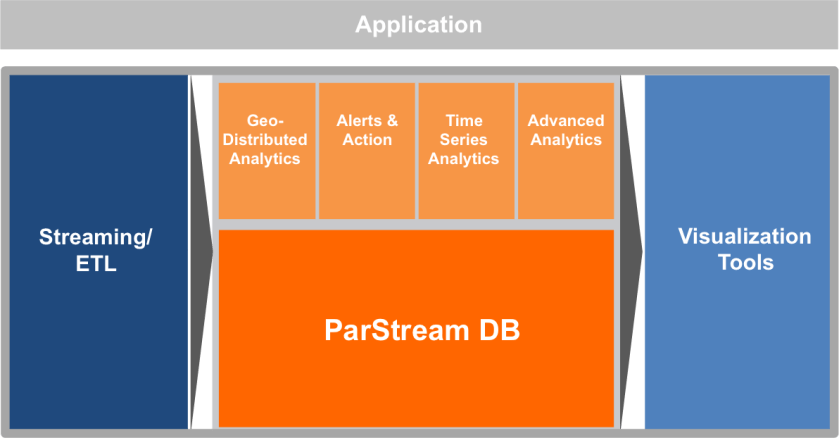
Featuring ParStream DB, a patented database designed to handle the storage of massive amounts of data and real-time analytics, the ParStream platform boasts sub-second query response times, the ability to analyze billions of rows of data and time series analytics that analyze incoming, real-time data feeds in conjunction with historical data. Moreover, ParStream’s Geo-Distributed analytics server enables data analytics and data visualization on distributed datasets in ways that accommodate the disparate data storage infrastructures of contemporary global IT organizations. ParStream’s bevy of analytic offerings sit atop the ParStream DB as illustrated below:

As the graphic illustrates, ParStream’s internet of things analytics platform delivers a diverse range of analytic engines that operate upon massive volumes of data resulting from appliances, wearable devices, automobiles and sensors. Moreover, the platform boasts data acquisition qua ETL/streaming technologies and data visualization technology that collectively delivers a turnkey solution for internet of things use cases. As told to Cloud Computing Today in an interview with ParStream’s CEO, Peter Jensen, the ParStream solution absolves customers of the necessity of cobbling together disparate technologies that often struggle to integrate with one another by delivering instead a holistic solution for internet of things analytics that has few counterparts in the industry to date. The conjunction of the platform’s database and advanced analytics technologies renders it especially well suited for the massive, high velocity datasets specific to the internet of things space, particularly given its real-time analytic functionality on streaming datasets and capability to change the direction of its analytics as data evolves. More generally, the platform illustrates the Big Data industry’s increasing preoccupation with real time analytics on massive, streaming datasets and the concomitant challenges associated with storing incoming data and the results of analytic operations on the data in question.

Teradata and Cloudera Partner To Optimize Integration Of Big Data Platforms In Teradata Unified Architecture

Teradata today announced a partnership with enterprise Hadoop vendor Cloudera marked by the optimization of the integration between Teradata’s integrated data warehouse and Cloudera’s enterprise data hub. The collaboration between Teradata and Cloudera streamlines access to multiple data sources by means of the Teradata Unified Data Architecture (UDA). As a result of the integration, the Teradata Unified Data Architecture can access data from the Cloudera enterprise data hub by way of a unified Big Data infrastructure that has the capacity to perform data operations and analytics on massive, heterogeneous datasets featuring structured and unstructured data. As part of today’s announcement, Teradata also revealed details of Cloudera-certified connectors that can integrate with Apache Hadoop. Other components of the UDA that interface with Cloudera’s enterprise data hub include the Teradata QueryGrid, which allows users to pose analytical questions of data in both Teradata’s integrated data warehouse and the Cloudera enterprise data hub, in addition to the Teradata Loom, which enables tracking, exploration, cleansing and transformation of Hadoop files. Today’s announcement of the integration between Teradata’s integrated data warehouse and Cloudera’s enterprise data hub signals an important development in the Big Data space insofar because the alignment of the product roadmaps of the two vendors promises to position Teradata strongly via-a-via the development of Big data analytics and processing functionality. On Cloudera’s side, the partnership renders its enterprise data hub even more compatible with one of the industry’s most respected Big Data analytic platforms and prefigures the inking of even more partnerships between Hadoop and Big Data management vendors as a means of continuing to foster deeper hardware and software integration in the Hadoop management space.